
How to calm your horse
There is almost nothing more stressful than seeing your beloved horse in distress. Whether your horse has chronic anxiety or has reacted to a specific trigger, it is easy to feel helpless as you watch your horse fret.
Learning to calm your horse is relatively simple – in fact, the most difficult part is usually learning to calm ourselves!
If you are able to be a source of calm and comfort for your horse, you will be very well placed to help it calm down in times of high stress.
Creating a calm connection
Creating a calm and trusting connection with your horse is best done over time, consistently and before you “need” it.
1. Be calm
Often we bring our own stress and anxiety to the stable. Our horses pick up on this and it can cause them to also feel anxious.
Take a moment before you visit your horse to take a few deep breaths and let go of any worries you have. Focus your attention on your horse, your interactions and your communications. Try to be fully present with your horse as much as possible. If you are still thinking about other things you may send mixed messages to your horse, which is why you need to be present.
If you have become anxious specifically about interacting with your horse – perhaps due to an accident or behavioural issues your horse has had that makes it unpredictable or even dangerous – you may need to work through your own anxiety before you can be helpful to your horse.
2. Build trust
Although our horses can’t tell when we are lying in the same way that humans can, they do understand inconsistency, lack of reliability and cruelty as untrustworthy behaviours.
It is important that your words and your actions are consistent with each other. Your horse can pick up a conflict between your body language and what you are saying, just as a human would. Similarly, changes in your actions, communication or mood from day to day will be unsettling to your horse.
Consistency also includes routine. When your horse can rely on you to appear, provide food or exercise at regular times, for example, it helps establish trust.
3. Provide a safe space
Ensure your horse has a safe space it can be in, particularly when it is feeling stressed. Take care to consider all aspects of the space.
Check for things that may trigger anxiety. Are there loud or unexpected noises on a regular basis? Do passing headlights flash into the space?
Depending on your horse’s personality, can you arrange for it to either be separated from other horses or have company as it prefers?
4. Be your horse’s source of comfort
Although much easier if you have already established a calm connection with your horse over time, anyone can be a source of comfort. When your horse is anxious, you can offer it comfort through
· Speaking in a calm and soothing tone; using repeating phrases, terms of affection and your horse’s name as well as soothing noises
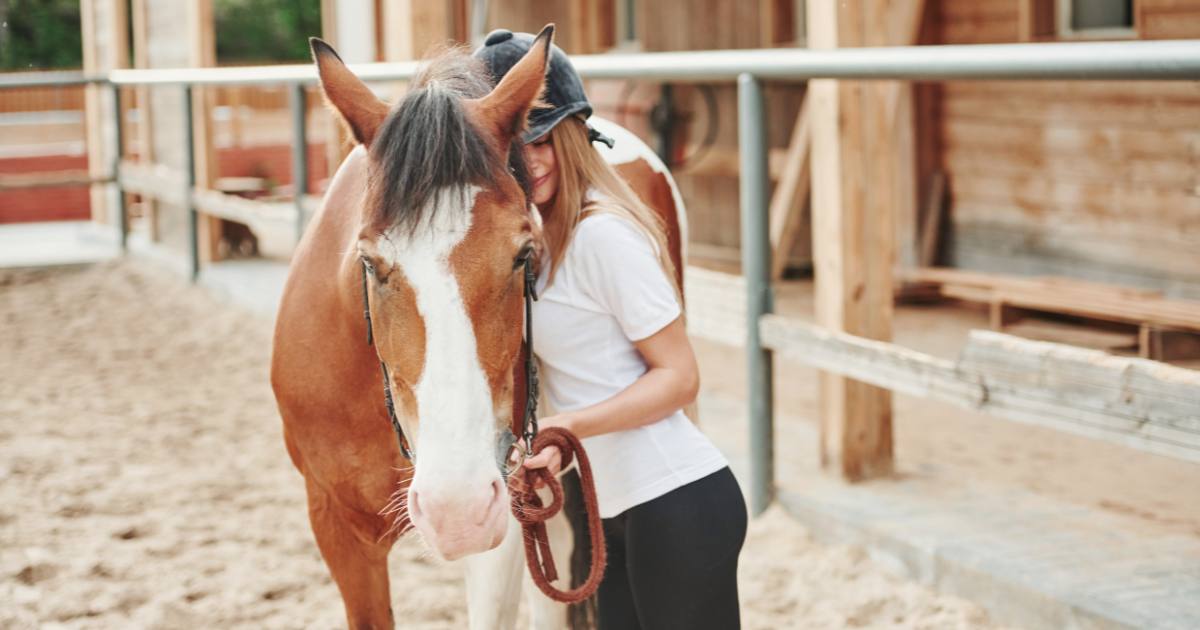
· If your horse is happy for you to approach it (and if it is safe for you to do so), provide soothing touch through stroking, massage or hugging
· Meditate with your horse, slow your breath and still your body, allowing your horse to pick up on your calm body language, facial expressions and mood
5. Help your horse release excess energy
Anxiety is often accompanied by excess energy – or it may be caused by it. Regular exercise, perhaps at higher levels than has been regular for your horse, may help it to calm and self-regulate better.
It is also worth experimenting with exercise at different times of the day to see if your horse responds better to a morning or evening workout.
Consider how much time your horse is contained in its stable and how much time it is able to roam free each day. Your horse may benefit from additional time outside – particularly if it is able to spend time with another horse. Horses are herd animals so social contact is important and they can encourage each other to play as well.
Prior to doing any structured activity with your horse, it can be good to help your horse release any pent up energy first. Lunging your horse is one way to do this.
6. Be persistent and consistent
Some horses will respond quickly to your efforts to calm them, others will take a long time. Choose what approach you are going to take and work on it consistently. Even if you don’t see a change immediately, persist with your efforts and you’ll almost certainly succeed – and build a much deeper connection with your horse in the process.
